
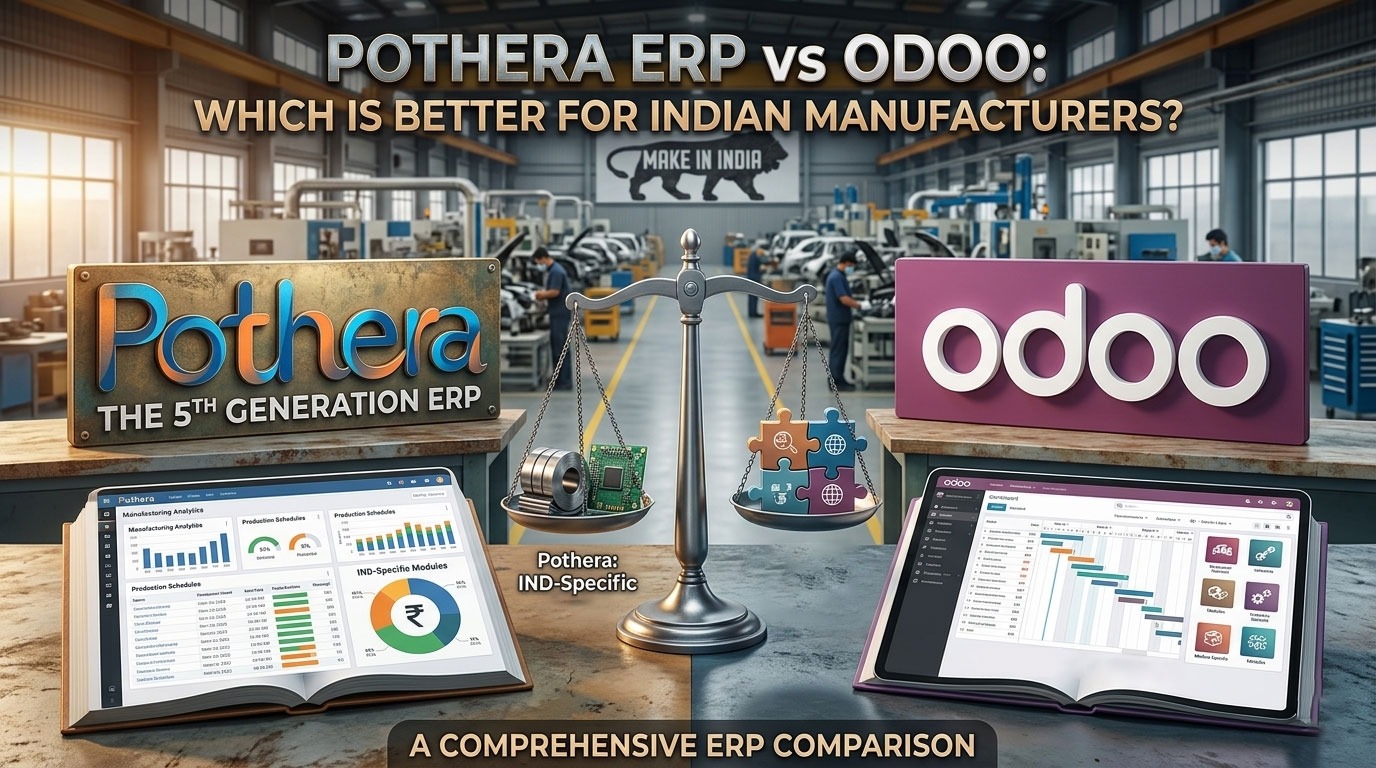
Pothera ERP and Odoo both target Indian manufacturing SMEs, but they represent fundamentally different buying decisions. Odoo is a modular platform with per-user pricing and a partner ecosystem in India. Pothera ERP is a managed, India-built platform with pre-configured manufacturing workflows, fixed implementation ownership, and 25 years of Indian factory floor experience. The right choice depends on whether your priority is pricing flexibility or implementation certainty.
This comparison is for manufacturing business owners, operations heads, and CFOs in India who have Odoo and Pothera ERP on their shortlist and want a direct, honest assessment before making a decision.
Bsquare builds and implements Pothera ERP. We compete with Odoo regularly in sales conversations. We are stating that clearly upfront. What follows is written to help you make the right decision for your business, not to win every comparison. A manufacturer who buys the wrong ERP wastes 12 to 24 months and significant capital. We have seen that outcome enough times to prefer accuracy over persuasion.
Odoo vs Pothera ERP India
Choose Odoo if: You are cost-sensitive, have some internal IT capability or a strong implementation partner already identified, your manufacturing processes are relatively standard, and you value Odoo’s modular flexibility to start small and add capabilities over time.
Choose Pothera ERP if: You are a mid-market Indian manufacturer in automotive, steel, fabrication, electronics, cables and wires or food processing, you want the ERP vendor to own implementation and post-go-live support, your operation involves complex job work or sub-contracting workflows, and you need manufacturing-specific configuration ready at go-live rather than built over months.
Pothera ERP vs Odoo: Eight Dimensions That Matter to Indian Manufacturers
| Dimension | Pothera ERP | Odoo |
| Pricing model | One-time user license plus implementation fee. No recurring monthly per-user charge. | Per-user per month, Enterprise from approx. Rs 2,000 to 2,500 per user |
| India implementation cost | Included in Bsquare engagement | Rs 3 lakh to Rs 40 lakh plus, partner-dependent |
| Implementation ownership | Bsquare owns timeline and outcome | Partner-dependent, quality varies significantly |
| Manufacturing depth | Pre-configured for 15 plus Indian industries | Strong core MRP, industry config requires partner work |
| Job work and sub-contracting | Dedicated module, ITC-04 compliant, insource and outsource | Available, multi-level sub-contracting requires careful configuration |
| GST compliance | Built-in, Bsquare-maintained, e-invoicing ready | Available, partner must configure correctly |
| Post-go-live support | Bsquare managed, SLA-backed | Partner-dependent |
| Best for | Mid-market Indian manufacturers, 5Cr to 500Cr revenue | Cost-sensitive SMEs with IT capability or strong partner |
What Odoo Actually Costs in India vs What the Website Shows
Odoo’s marketing leads with its Community Edition, which is free and open-source. This is accurate but misleading for manufacturing businesses. The Community Edition lacks e-invoicing integration, advanced manufacturing workflows, mobile apps, and official support. Most Indian manufacturers who need a serious ERP require Odoo Enterprise.
Odoo Enterprise pricing in India runs approximately Rs 2,000 to Rs 2,500 per user per month at current exchange rates. For a 25-user manufacturing operation, that is Rs 50,000 to Rs 62,500 per month in licensing alone, or Rs 6 lakh to Rs 7.5 lakh per year, before implementation.
Implementation ERP cost in India for a manufacturing company ranges from Rs 3 lakh for a basic SME deployment to Rs 40 lakh plus for a complex multi-site manufacturing operation, based on current partner pricing data. The wide range reflects partner quality variance, which is the central risk in any Odoo implementation.
Pothera ERP uses One-time user license plus implementation fee. No recurring monthly per-user charge, which means cost does not scale linearly as your headcount grows. For a manufacturer adding users over time, this model typically favors Pothera at the 3-year TCO comparison. Contact Bsquare directly for current pricing against your specific user count and module requirements.
Where Each System Stands on Manufacturing
Job work and sub-contracting: the sharpest difference between the two systems
Indian manufacturing is characterized by extensive job work, where raw materials are sent to external vendors for processing and returned as semi-finished or finished goods. This is not a niche workflow. It is standard practice in automotive, fabrication, electronics, and textile manufacturing across India. GST compliance for job work requires ITC-04 quarterly filings tracking material movement to and from job workers.
Pothera ERP has a dedicated job work module covering both outsource and insource scenarios. It manages material issue to job work vendors across multiple challans, tracks actual versus standard material consumption, handles job work scrap returns, manages tolerance limits and substitute items, and generates complete traceability of materials sent out and returned. This module is pre-configured and has been refined across hundreds of Indian manufacturing implementations.
Odoo’s subcontracting module handles the core workflow: linking subcontracting purchase orders to production orders, tracking materials sent to external vendors, and receiving finished components back into inventory. Where Indian manufacturers encounter configuration complexity in Odoo is in multi-level sub-contracting scenarios, where the same product passes through multiple external vendors before returning, and in ITC-04 compliance tracking. These scenarios are solvable in Odoo but require careful partner configuration and testing before go-live.
Production planning and quality:
Both systems handle BOMs, work orders, and production scheduling. Pothera quality management module covers process-wise quality assessment at every production stage, WIP inspection, SFG and FG inspection, pre-dispatch inspection, and rejection reason analysis. These checkpoints are pre-configured for manufacturing industries. Odoo’s quality module is capable but requires configuration per industry and per process stage.
Machine and shift-wise analysis:
Pothera ERP includes machine-wise, shift-wise, and operator-wise production analysis as standard reporting. This matters for manufacturers running multi-shift operations and trying to identify bottlenecks at the shop floor level. In Odoo, this level of operational granularity typically requires custom development or third-party app installation.
GST Compliance: Built-in vs Configured
Both Pothera ERP and Odoo Enterprise support Indian GST, e-invoicing, e-way bill generation, GSTR-1, GSTR-3B, and TDS. The difference is maintenance and accountability.
Pothera ERP’s compliance layer is maintained by Bsquare’s internal team. When the government changes e-invoicing applicability thresholds, updates IRN generation requirements, or modifies GST return formats, Bsquare pushes updates to all clients under maintenance contracts. The manufacturer does not need to track government notifications or chase their partner to apply patches.
Odoo’s GST compliance depends on the localization package maintained by the Indian Odoo community and your specific implementation partner. The localization is generally current and well-maintained. Where the risk sits are in your partner’s responsiveness to compliance updates. A well-run Odoo partner keeps clients current. A poorly run one does not, and the manufacturer carries the compliance gap.
For a manufacturer processing high invoice volumes across multiple states, the managed compliance model reduces operational risk. For a manufacturer with internal finance capability who actively monitors GST notifications, either system works.
What Implementation Actually Looks Like for Each System
This is the section that changes buying decisions more than any feature comparison.
Pothera ERP implementation:
Bsquare assigns a project manager, functional consultant, and technical resource to every implementation. Discovery, configuration, training, and go-live support run in four defined phases. For a 10 to 50 user manufacturing company, implementation completes in 10 to 12 weeks. Bsquare owns the outcome. If something does not work after go-live, Bsquare fixes it under the maintenance contract.
The variables that extend Pothera timelines are always on the client side: master data quality, internal process clarity before go-live, and management commitment to user adoption. In 25 years and 1,000 plus implementations, those three factors account for the majority of timeline extensions.
Odoo implementation in India:
Odoo has a large and growing partner network in India, with certified partners in Delhi NCR, Bangalore, Mumbai, Chennai, and Ahmedabad. The best Indian Odoo partners deliver clean, well-configured manufacturing implementations in 12 to 20 weeks. The weakest deliver under-configured systems requiring months of post-go-live fixes.
The three questions that separate strong Odoo partners from weak ones in manufacturing contexts are: How many manufacturing implementations have you completed in the last 24 months, specifically in my industry? Who is the specific consultant handling my project, and what is their manufacturing ERP experience? What is your documented process for handling scope changes during implementation?
If an Odoo partner cannot answer all three specifically, the implementation risk is high regardless of how competitive their price is.
Choose Pothera ERP if you match this profile:
You are a manufacturer generating between 5 crore and 500 crore in revenue. Your industry is automotive, steel, fabrication, electronics, copper, food processing, or packaging. You have 10 to 150 users. You want one vendor to own implementation, support, compliance updates, and customization. You do not have internal IT resources to manage an ERP platform independently. You operate across multiple locations in India or have international operations in UAE or Africa.
Choose Odoo if you match this profile:
You are cost-sensitive and want to start with a smaller module set and expand over time. You have identified a strong Odoo partner with documented manufacturing experience in your specific industry. You have some internal IT capability to manage the platform. Your manufacturing processes are standard enough that Odoo’s core modules cover your needs without extensive customization. You value Odoo’s global ecosystem, including integrations with international platforms and the ability to switch partners if needed.
The profile that should not choose Odoo without caution:
A manufacturer with complex multi-level job work, no internal IT team, and no prior relationship with a specific Odoo partner. This buyer is most exposed to the partner quality variance that is Odoo’s central risk in India.
Frequently Asked Questions
Q1: Can I migrate from Odoo to Pothera ERP?
Yes. Bsquare has completed migrations from Odoo to Pothera ERP for manufacturers who needed deeper India-specific manufacturing workflows or preferred a managed support model. Migration covers master data export from Odoo, data mapping and cleaning, Pothera configuration, parallel running for 4 to 6 weeks, and cutover. Timelines for mid-sized manufacturing companies average 12 to 16 weeks. Contact Bsquare for a migration assessment based on your Odoo module usage and data structure.
Q2: Does Odoo handle Indian job work compliance better now than it did in earlier versions?
Odoo’s subcontracting module has improved significantly through versions 16, 17, and 18. It now handles core job work scenarios including material issue, receipt, and consumption tracking linked to production orders. The area that still requires careful partner configuration is multi-level job work, where materials pass through more than one external vendor before returning, and ITC-04 quarterly reporting for GST purposes. Pothera ERP’s job work module was built specifically for Indian manufacturing job work scenarios and covers both insource and outsource workflows with ITC-04 compliance as a standard feature.
Q3: Is Odoo Community Edition suitable for manufacturing companies in India?
For most manufacturing companies in India, Odoo Community Edition is insufficient as a primary ERP. It lacks e-invoicing integration, which is mandatory for businesses above Rs 5 crore turnover, mobile applications, advanced manufacturing features available only in Enterprise, and official Odoo support. Manufacturers evaluating Odoo should budget for Enterprise Edition licensing from the start and factor per-user monthly costs into their 3-year TCO calculation alongside implementation and partner fees.
Q4: What happens if my Odoo partner closes down or loses key staff?
This is a real and underappreciated risk in Odoo implementations. Because Odoo is open-source and partner-delivered, your ERP support is tied to your partner firm, not to Odoo directly. If your partner loses the consultant who configured your system, or if the firm closes, you face a re-implementation or re-onboarding cost with a new partner who needs to understand your customizations from scratch. With Pothera ERP, Bsquare owns the product and the support relationship directly. There is no partner intermediary between your business and the people who built the system.