
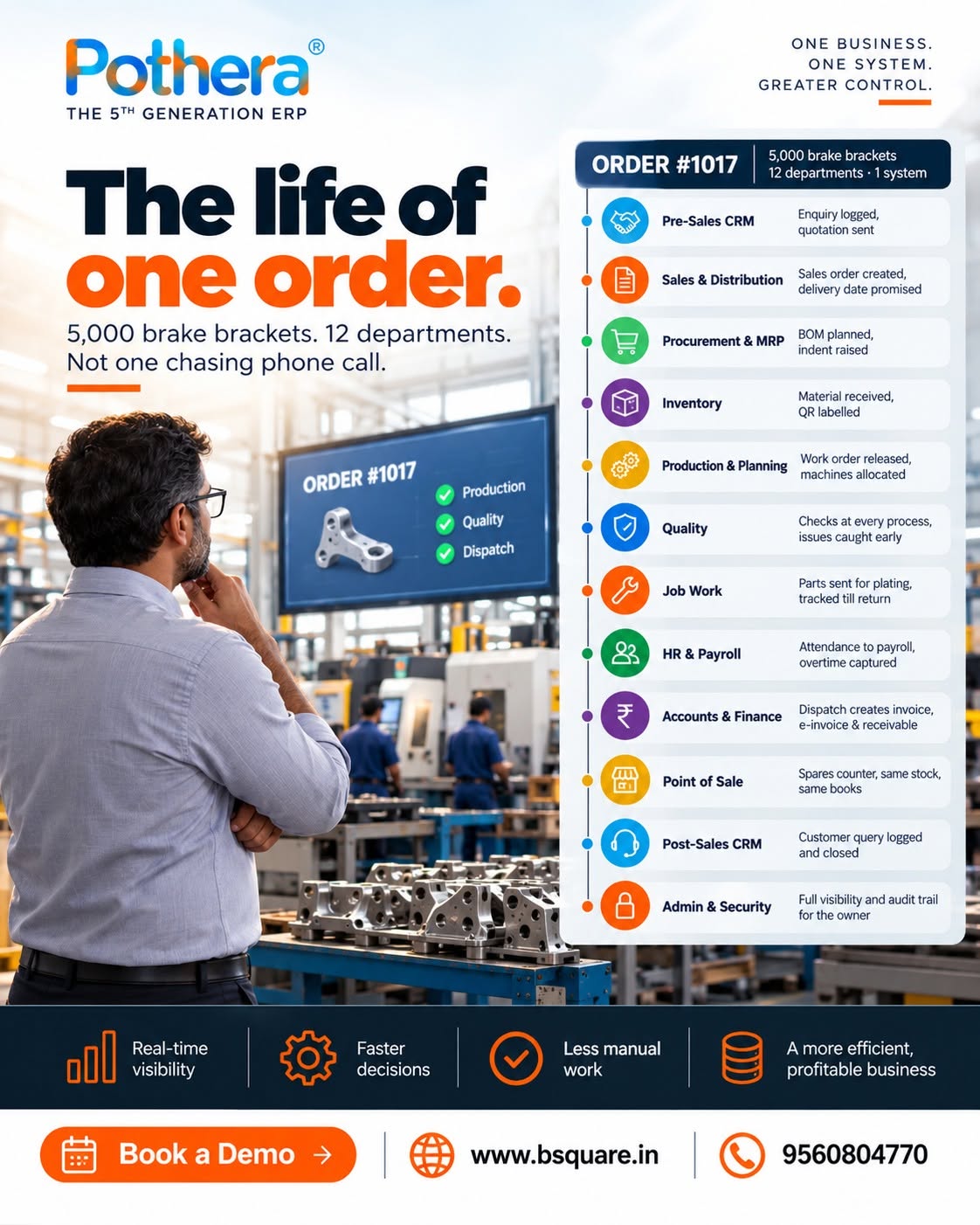
Discover how integrated ERP software connects production, inventory, finance, and purchasing to support growing Indian manufacturing companies.
Many Indian manufacturing companies begin their journey with accounting software and spreadsheets. These tools help manage invoices, payments, expenses, and financial records. However, as a business grows, managing production, raw materials, stock movements, and customer orders becomes more complicated.
This is where the difference between accounting software and Manufacturing ERP becomes important.
Accounting software primarily focuses on financial transactions. Manufacturing ERP connects finance with production, inventory, procurement, sales, and other business operations. Choosing the right system depends on your company’s size, complexity, and future growth plans.
- What Is Accounting Software?
Accounting software helps businesses manage their financial activities. Common functions include bookkeeping, invoicing, payment tracking, ledger management, taxation, and financial reporting.
For small businesses with straightforward operations, accounting software may be sufficient. It helps maintain financial records and supports routine accounting activities.
However, accounting software may not provide the complete production planning, material requirements, shop-floor tracking, and inventory coordination that a manufacturing business needs. Additional tools or integrations may be required.
- What Is Manufacturing ERP Software?
Manufacturing ERP is an integrated business management system designed to connect different departments within a manufacturing company.
It can bring together production planning, inventory management, purchasing, sales, finance, and reporting through shared business data. The exact functionality depends on the ERP product and its configuration.
For example, when a customer order is confirmed, an integrated ERP workflow can help teams review material availability, production requirements, purchasing needs, and delivery schedules.
Bsquare Solutions offers Pothera as an ERP option for businesses evaluating integrated operations. Manufacturers should assess its available modules and workflows through a practical product demonstration before making a decision.
- Manufacturing ERP vs Accounting Software: Key Differences
The main difference is the scope of business management.
| Business Function | Accounting Software | Manufacturing ERP |
| Financial accounting | Core functionality | Integrated financial management |
| Invoice and payment tracking | Commonly available | Available depending on modules |
| Inventory management | Basic or integrated features may be available | Can connect inventory with wider workflows |
| Production planning | Usually limited | Can support production planning |
| Bill of materials | Often requires another tool | May be supported through manufacturing modules |
| Purchase management | Financial and transaction-focused | Can connect procurement with stock and production |
| Business reporting | Primarily financial | Can combine operational and financial information |
| Multi-department coordination | May require separate systems |
Designed for integrated workflows |
The important point is not that accounting software is unsuitable for every manufacturer. Instead, businesses should identify whether their current system can support the operational complexity they have reached.
- How Can ERP Help with Production Planning?
Production planning requires information about customer orders, raw materials, machine capacity, workforce, and manufacturing schedules.
Manufacturing ERP can help coordinate these requirements by connecting production orders with bills of materials, inventory balances, purchasing activities, and planned schedules.
For example, if a factory receives an order for 5,000 components, the production team needs to know whether sufficient raw materials are available. If stock is insufficient, the purchasing team may need to arrange replenishment before production begins.
An integrated ERP workflow helps departments access relevant information and coordinate their activities. Actual planning capabilities depend on the selected system and its configuration.
- How Can Manufacturers Connect Inventory Information with Production Requirements?
Manufacturers can connect inventory and production through integrated ERP workflows that use bills of materials, stock balances, material consumption, and production orders.
Inventory ERP software can help track available quantities, stock movements, warehouse locations, and material requirements. When connected with production planning, this information helps teams identify shortages and plan replenishment.
Real-time visibility also supports better coordination between warehouse, procurement, and production teams. Businesses should verify whether their chosen software supports the required level of stock tracking, material planning, and reporting.
- GST, E-Invoicing and ERP Automation
Both accounting software and ERP software may support GST-related processes and e-invoicing integrations. The difference lies in how these activities connect with the wider business workflow.
An integrated ERP Software system can link sales orders, dispatch information, invoices, inventory records, and financial entries where the relevant functionality is available.
Manufacturers should verify current GST requirements, e-invoicing applicability, integration capabilities, and reporting needs before selecting a solution. Automation should improve accuracy while maintaining suitable checks and approvals.
- AI-Enabled ERP and Smart Manufacturing
AI-enabled ERP capabilities are creating new opportunities for manufacturers. Depending on the product, AI tools may assist with demand forecasting, identifying unusual inventory patterns, analysing operational data, or generating business insights.
However, AI is not a replacement for accurate records and well-defined processes. Businesses should first establish reliable data across inventory, production, purchasing, and finance.
Growing SMEs should evaluate practical AI use cases and confirm which features are available in the proposed ERP system.
- ERP Implementation Timeline for Growing SMEs
The ERP Implementation Timeline depends on the number of modules, business complexity, data quality, integrations, customisation, and employee readiness.
A typical project includes requirement analysis, process mapping, data migration, configuration, testing, employee training, go-live, and ongoing support.
Some focused implementations may take several weeks, while complex manufacturing projects may require several months or longer. A reliable ERP Software Company should provide a realistic project plan with clear milestones, responsibilities, and support arrangements.
Frequently Asked Questions
- Is Manufacturing ERP better than accounting software?
Manufacturing ERP is generally more suitable when a business needs integrated production, inventory, purchasing, sales, and finance workflows. Accounting software may remain sufficient for simpler operations.
- Can accounting software manage manufacturing inventory?
Some accounting systems offer inventory features, but advanced production planning, bills of materials, material requirements, and shop-floor tracking may require additional functionality.
- When should a manufacturer switch to ERP software?
Consider ERP when disconnected systems cause stock mismatches, production delays, repeated manual entry, limited reporting, or difficulty coordinating multiple departments.
- How do I choose an ERP Software Company in India?
Compare manufacturing capabilities, implementation experience, data migration, GST-related functionality, training, support, integration options, and total project costs before selecting a provider.
- Can Pothera support integrated manufacturing operations?
Businesses considering Pothera should request a demonstration covering their production, inventory, procurement, and financial workflows, then verify module availability, integration requirements, and implementation scope.
Accounting software remains valuable for financial management, but growing manufacturing companies may need broader operational control. Manufacturing ERP can connect production, inventory, purchasing, sales, and finance through integrated workflows.
Bsquare Solutions and Pothera are options to evaluate when exploring ERP for Indian manufacturing businesses. The best choice depends on business requirements, available functionality, implementation readiness, and long-term objectives.
Before selecting a system, compare both options using your actual business processes. The right decision can help your company improve coordination, strengthen operational visibility, and prepare for sustainable growth.