
A practical guide to integrating production, inventory, finance, and business operations with the right ERP implementation strategy.
Indian manufacturing companies are growing rapidly, but many businesses still manage their operations through spreadsheets, separate accounting tools, and disconnected software. This approach can create inventory mismatches, production delays, manual errors, and limited business visibility.
ERP for manufacturing industry – ERP software helps manufacturers connect important business functions through an integrated system. It brings departments such as purchase, production, inventory, sales, and finance onto a common platform.
For growing manufacturers, Bsquare Solutions offers Pothera as an ERP option to evaluate for integrated business operations. A well-planned ERP implementation helps businesses improve coordination, access timely information, and make better operational decisions.
- Identify Your Manufacturing Business Requirements
The first step in ERP implementation is understanding your current business processes. Every manufacturing company has different requirements based on its industry, production methods, inventory structure, and business size.
Identify the major challenges in your existing system. These may include production planning delays, incorrect stock records, purchase coordination problems, or difficulty tracking manufacturing costs.
Prepare a list of essential requirements before selecting an ERP Software Company. Include production planning, inventory control, procurement, order management, accounting, and reporting.
Clear requirements help businesses select suitable ERP software without paying for unnecessary features.
- Connect Production Planning with Inventory Management
Production planning depends on the availability of raw materials, machine capacity, workforce, and customer demand. When inventory and production information remain disconnected, manufacturers may experience material shortages or unnecessary purchases.
Integrated ERP software can connect production requirements with stock availability, purchase orders, and material consumption records.
How can ERP help with production planning?
ERP helps manufacturers coordinate production orders, material requirements, stock availability, and planned schedules. This visibility supports better resource allocation, fewer avoidable delays, and improved coordination between production and purchase teams.
Inventory management software also helps businesses monitor stock movements, reorder requirements, and warehouse balances. When evaluating Inventory ERP software, check whether it supports your actual manufacturing workflows.
- Integrate Purchasing, Finance, and GST Workflows
Manufacturing operations involve multiple connected activities. A purchase order affects inventory, supplier payments, production planning, and financial reporting.
An integrated ERP system helps departments work with shared business information instead of maintaining separate records.
Manufacturers should also evaluate GST-related workflows, invoice generation, e-invoicing integrations, and financial reporting. The system should support applicable compliance requirements and be configured according to current regulations.
Automation can reduce repetitive data entry and improve record consistency. However, businesses should verify the software’s actual capabilities, integration requirements, and compliance coverage before implementation.
- Plan Data Migration and System Configuration
Moving from spreadsheets or existing accounting software requires careful preparation. Incorrect or duplicate records can create problems after the new ERP system becomes operational.
Clean and validate important data before migration. This may include product codes, customer records, supplier details, opening stock, bills of materials, and outstanding transactions.
Configure the ERP system according to approved business processes. Test important workflows, such as receiving raw materials, issuing materials to production, recording finished goods, and generating sales invoices.
Involve department heads and key users throughout this stage. Their feedback helps identify process gaps before the system goes live.
- Understand the ERP Implementation Timeline
The ERP Implementation Timeline depends on business size, module selection, data quality, customisation, integrations, and user readiness.
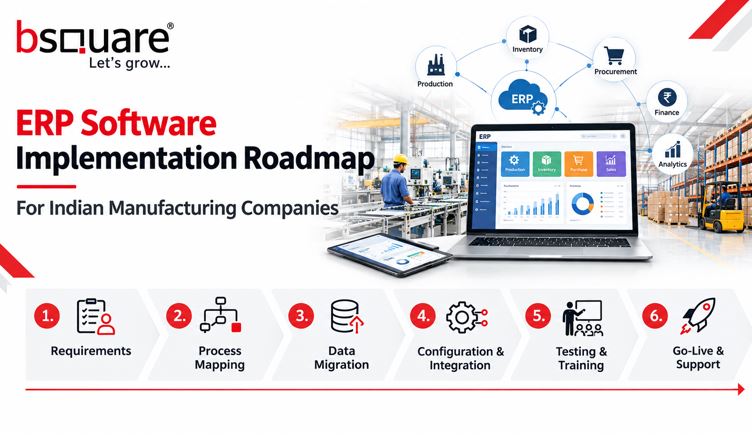
A typical implementation follows these stages:
- Requirement analysis: Document business needs and existing challenges.
- Process mapping: Define how departments will use the system.
- Data migration: Prepare, clean, and transfer business records.
- Configuration and integration: Set up modules and required connections.
- Testing and training: Validate workflows and prepare employees.
- Go-live and support: Start live operations and resolve early issues.
Some focused implementations may take several weeks, while complex manufacturing projects can require several months or longer. Businesses should agree on realistic milestones with their implementation partner.
- Explore AI-Enabled ERP and Smart Manufacturing
AI-enabled ERP capabilities are becoming an important consideration for manufacturers. Depending on the available features and data quality, AI can assist with demand forecasting, identifying unusual patterns, and generating operational insights.
Manufacturers should evaluate practical use cases rather than selecting a system based only on AI-related claims.
Start by ensuring that production, inventory, purchasing, and financial information is accurate and connected. Reliable data provides a stronger foundation for future automation and smarter decision-making.
- Improve Real-Time Inventory and Production Visibility
How can manufacturers connect inventory information with production requirements?
Manufacturers can connect production orders, bills of materials, inventory balances, and material consumption records through integrated ERP workflows. This helps teams identify shortages, plan replenishment, and monitor production progress.
Inventory ERP software should provide suitable visibility into stock by item, warehouse, batch, or location where required. Production teams can use this information to coordinate material availability with planned schedules.
For growing SMEs, these connected workflows can support better planning and reduce dependence on manual reporting.
Frequently Asked Questions
- What is ERP software implementation?
ERP software implementation is the process of analysing business requirements, configuring software, migrating data, testing workflows, training employees, and launching an integrated business management system.
- How long does ERP implementation take in India?
ERP implementation may take several weeks to several months or longer. The timeline depends on business complexity, data readiness, integrations, customisation, and employee training.
- What is the difference between ERP software and inventory management software?
Inventory management software focuses primarily on stock control. ERP software can connect inventory with production, procurement, sales, finance, and other business functions.
- How should manufacturers choose an ERP Software Company?
Manufacturers should evaluate industry experience, product capabilities, implementation methodology, data migration support, training, integration options, ongoing assistance, and the clarity of the project scope.
- Can ERP software help Indian manufacturing SMEs?
Yes. Suitable ERP software can help SMEs coordinate purchasing, production, inventory, sales, and finance. The right solution depends on operational requirements, implementation readiness, and available resources.
A successful ERP implementation starts with clear business requirements, reliable data, connected workflows, and employee involvement. Indian manufacturers should prioritise practical integration over unnecessary customisation.
Bsquare Solutions and Pothera can be considered as part of an ERP evaluation for businesses seeking to integrate manufacturing and business operations. Before making a decision, request a practical demonstration using your actual production, inventory, purchasing, and accounting scenarios.
The right implementation roadmap can help manufacturers build a more connected, visible, and scalable operation.