
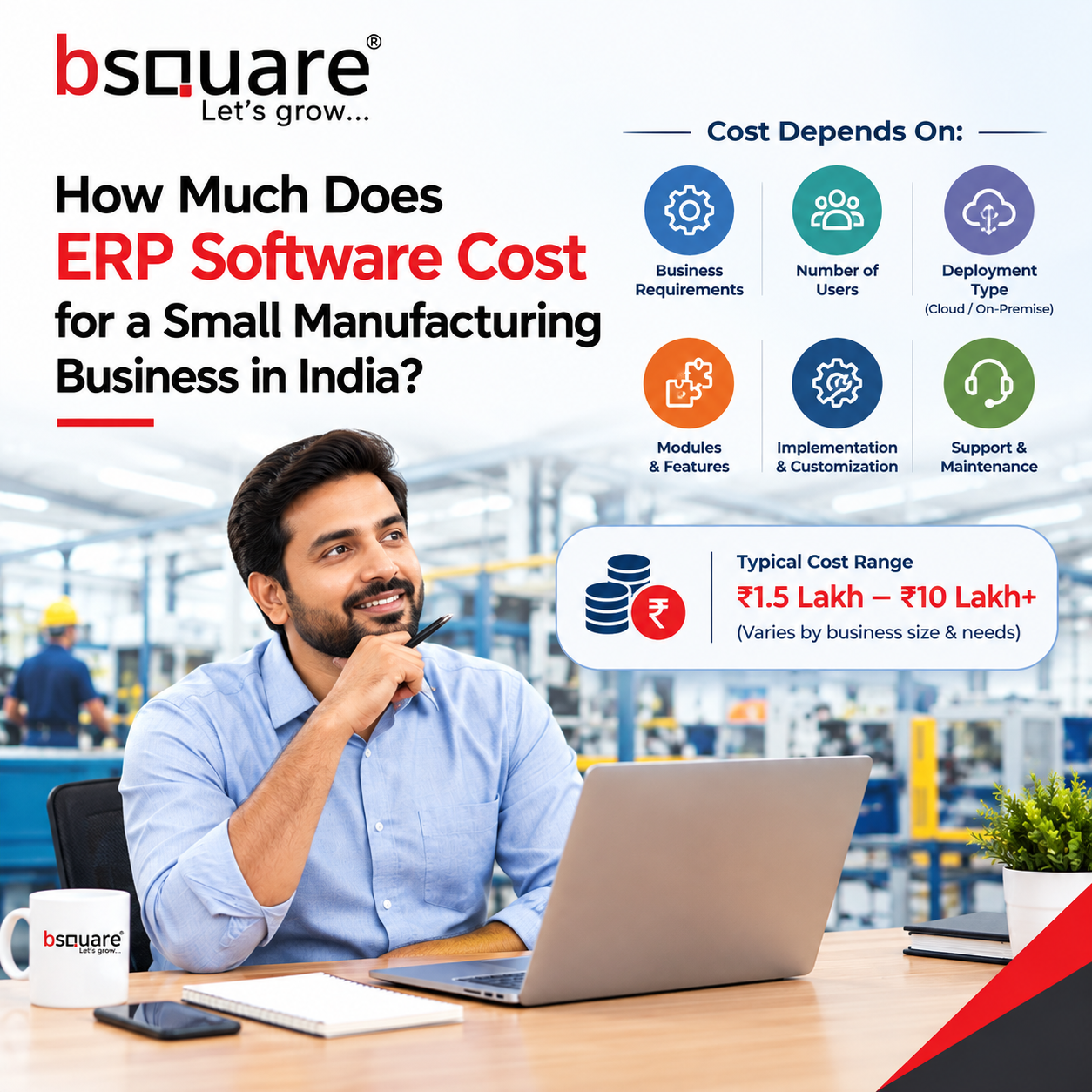
Planning to invest in manufacturing ERP software? Understand what determines ERP pricing in India, the costs businesses often overlook and how to evaluate an ERP quotation before making a decision.
The cost of ERP software for a small manufacturing business in India depends on the number of users, modules required, manufacturing complexity, implementation scope, customisation, deployment infrastructure and ongoing support.
There is no single price that applies to every manufacturing business.
A company with ₹15–20 crore in annual revenue may have different ERP requirements from another company of the same size. One may operate from a single manufacturing facility, while another may manage multiple warehouses, specialised production processes or several business locations.
Consequently, comparing ERP quotations only on the basis of licence fees can be misleading.
For a growing manufacturer, the important question is not simply:
How much does ERP software cost?
It is:
How much will it cost to implement an ERP system that meets our business requirements and continues supporting our operations as we grow?
This guide explains the major components of manufacturing ERP costs in India, what to check in vendor quotations and how to approach ERP budgeting.
- What Determines Manufacturing ERP Software Cost in India?
ERP pricing generally depends on the scope of the proposed solution.
The following factors can significantly influence the total investment.
Number of ERP Users
The number of employees requiring system access is an important commercial consideration.
A small manufacturer may initially need ERP access for employees working in sales, purchase, stores, production, accounts and management.
As the business grows, additional users may require access.
Before requesting a quotation, identify how many people need to use the ERP and what functionality each role requires.
Ask the vendor whether its pricing follows a one-time licence model, a subscription model or another commercial structure.
ERP Modules Required
Not every manufacturing company requires the same ERP modules.
Common requirements include:
- Sales management
- Purchase management
- Inventory management
- Production management
- Finance and accounting
- Quality management
- GST and e-invoicing
- Management reporting
The precise functionality required within each module should be established during the requirement study.
For example, a company requiring basic inventory transactions may have a different scope from one requiring specialised material tracking or complex production processes.
Bsquare’s perspective: Manufacturers should begin with essential business requirements rather than purchasing functionality solely because it appears in a product brochure.
Manufacturing Process Complexity
Manufacturing businesses differ significantly in how they operate.
A company producing standardised goods may have different requirements from one managing customised orders or specialised manufacturing processes.
The ERP provider must understand these workflows before estimating the implementation effort.
Industry-specific requirements can influence configuration, customisation, testing and training.
Number of Locations
A manufacturing business operating from one facility may have simpler operational requirements than a business managing multiple factories, warehouses or branches.
Businesses should clarify whether the ERP needs to support multiple locations and how information should be managed across them.
Customisation Requirements
ERP software may provide standard functionality that addresses many business requirements.
However, some companies require additional workflows, reports, integrations or functionality.
These requirements can affect project cost and implementation time.
Before accepting a quotation, ask the ERP provider to distinguish clearly between standard functionality and chargeable customisation.
- What Are the Main Components of ERP Implementation Cost?
The total investment in ERP software may include several components beyond the software licence.
| Cost component | What it covers |
| Software licence or subscription | Rights to use the selected ERP software |
| Implementation | Agreed configuration, setup and implementation services |
| Customisation | Additional functionality outside the standard scope |
| Data migration | Agreed preparation, mapping and transfer of existing information |
| Third-party integration | Connections with external software or services |
| Cloud or server infrastructure | Hosting and infrastructure arrangements |
| Training | User training included in the agreed scope |
| AMC and support | Ongoing maintenance and support arrangements |
These components are not necessarily charged separately by every provider. Their treatment depends on the quotation and contract.
A manufacturer should request a clear breakdown of what is included, excluded or subject to additional evaluation.
- Is Cloud ERP Cheaper Than On-Premise ERP?
Cloud and on-premise ERP have different infrastructure and operating considerations.
With a cloud deployment, the business uses infrastructure hosted by a cloud service provider or another agreed hosting arrangement.
With an on-premise deployment, the business maintains the system on infrastructure under its own management or control.
Neither option is automatically less expensive in every situation.
The financial comparison should consider initial infrastructure requirements, recurring hosting charges, maintenance responsibilities, backup arrangements, security requirements and future expansion.
Cloud ERP considerations – Cloud deployment may reduce the need for a business to purchase and maintain certain infrastructure itself.
However, hosting and related services may involve recurring charges.
On-premise ERP considerations – On-premise deployment may require investment in servers, infrastructure management, backups and technical maintenance.
The company should evaluate whether it has the internal resources to manage these responsibilities.
Bsquare‘s perspective: Choose the deployment model according to operational and IT requirements, then compare the full cost over an appropriate period rather than considering only the initial expenditure.
Pothera ERP supports cloud and on-premise deployment options, subject to the agreed project requirements.
- How Much Does ERP Cost for a ₹15–20 Crore Manufacturing Company?
A manufacturer with annual revenue of approximately ₹15–20 crore may be considering ERP because its existing systems no longer provide sufficient coordination between departments.
For example, the business may currently use:
- Tally for accounting.
- Excel for inventory records.
- Separate spreadsheets for production information.
- Manual reports for management reviews.
Such a company may want one ERP system to manage sales, purchases, inventory, production, finance and GST-related requirements.
However, annual turnover alone cannot determine the ERP price.
Two companies with similar revenue may have very different numbers of users, manufacturing processes, operational locations and customisation needs.
A reliable quotation therefore requires a discussion of the company’s actual requirements.
Can a Manufacturing SME Buy ERP Software Under ₹20 Lakh?
Manufacturers frequently evaluate ERP solutions against a defined investment budget, including budgets below ₹20 lakh.
Whether a complete ERP project fits within that budget depends on the scope, licensing structure, number of users, implementation requirements and other applicable charges.
It would be misleading to assume that every manufacturing ERP project can be completed within ₹20 lakh – or that every business needs to spend that amount.
Before making a decision, ask the ERP provider to explain what functionality and services are included within the proposed budget.
- What Are the Hidden or Frequently Overlooked Costs of ERP?
When reviewing ERP quotations, businesses should pay particular attention to costs that may not be immediately apparent.
Third-Party Integrations – Some businesses need ERP to exchange information with existing applications or external service providers.
Integration requirements may involve additional development, testing or third-party charges.
The technical feasibility and commercial implications should be confirmed before the project begins.
Additional Customisation – A business may identify new requirements during implementation.
These should be assessed against the agreed project scope to establish whether additional work, cost or time is involved.
Cloud Infrastructure – Where third-party cloud infrastructure is used, hosting charges may apply separately from software licensing and maintenance.
Manufacturers should clarify the billing arrangement and renewal responsibilities.
Annual Maintenance and Support – ERP is a continuing business system rather than a one-time installation.
Businesses should understand the applicable AMC or support terms, including what services are covered and what activities are treated as additional work.
- How Long Does ERP Implementation Take, and Does Time Affect Cost?
Implementation duration and cost are closely related to project scope.
A straightforward requirement may need less configuration and customisation than a complex multi-location manufacturing implementation.
Pothera ERP has a documented implementation timeline of 8–12 weeks, depending on the requirement.
This is a reference timeline rather than a guarantee for every business.
Factors affecting implementation include data readiness, customisation, integrations, testing, user training and the availability of the customer’s project team.
Businesses should establish the project scope before treating any proposed implementation date as a firm commitment.
- How Can Manufacturers Control ERP Implementation Costs?
A disciplined selection and implementation process can help businesses make more informed ERP investments.
Define Essential Requirements First – Identify the functionality needed for regular operations.
Separate essential requirements from enhancements that can be considered later.
Involve Department Heads Early – Sales, purchase, stores, production and accounts teams should participate in the requirement study.
Their involvement helps clarify actual workflows before the implementation scope is finalised.
Prepare Existing Data – Review master data and identify inconsistencies before implementation.
The quality of existing information can affect the effort required to prepare the new system.
Avoid Unnecessary Customisation – Ask whether a requirement can be addressed through standard ERP functionality before commissioning additional development.
Clarify Commercial Terms – Confirm the licence structure, implementation services, infrastructure arrangements, support terms and treatment of future changes.
Evaluate the Total Cost – Compare quotations over a suitable period, including applicable recurring charges.
An initially lower quotation does not necessarily represent a lower overall investment if important requirements have been excluded.
- How Does Pothera ERP Fit the Requirements of Growing Manufacturers?
Pothera ERP is developed by Bsquare Solutions Pvt. Ltd., a Noida-based enterprise software company and part of The Nambiar Group.
Pothera is positioned for manufacturing and trading businesses, with a documented suitability range of approximately ₹10 crore to ₹500 crore in annual revenue.
Its functional coverage includes sales, purchase, inventory, production and finance, together with GST and e-invoicing readiness for the Indian market.
For manufacturers evaluating Pothera, Bsquare recommends beginning with a requirement discussion and product demonstration.
This helps establish the required modules, users, implementation scope, deployment arrangements and commercial proposal.
Bsquare’s approach is to align the ERP proposal with the manufacturer’s operational requirements rather than quote a universal price based solely on company turnover.
Businesses should also evaluate implementation responsibility, usability, technology, scalability and ongoing support alongside the financial proposal.
- What Should Be Included in a Manufacturing ERP Quotation?
Before selecting a vendor, manufacturers should request clarity on the following:
| Question | Why it matters |
| Which modules are included? | Defines functional scope |
| How many users are covered? | Clarifies licensing assumptions |
| What implementation services are included? | Defines project responsibilities |
| Is customisation required? | Identifies additional development |
| Are integrations included? | Clarifies external system requirements |
| Who provides hosting? | Establishes infrastructure responsibility |
| What is the implementation timeline? | Supports project planning |
| What are the AMC and support terms? | Clarifies ongoing commitments |
| How are future changes priced? | Helps assess long-term costs |
A quotation that addresses these questions provides a stronger basis for evaluation than a single headline price.
Frequently Asked Questions About ERP Software Pricing in India
What is the average cost of ERP software for small businesses in India?
There is no single reliable price applicable to every small business. ERP cost depends on users, modules, implementation scope, deployment, customisation and ongoing services. A requirement-based quotation is more useful than an unsupported average.
Is manufacturing ERP software expensive?
The cost depends on the complexity of the required solution. Businesses should evaluate ERP investment against their operational needs and the total proposed cost rather than categorising every ERP system as inexpensive or expensive.
Can a ₹15–20 crore manufacturing business implement ERP?
Yes. Businesses in this revenue range can evaluate ERP solutions suited to their processes and requirements. Pothera ERP’s documented suitability range includes manufacturing and trading businesses of approximately ₹10–500 crore in annual revenue.
Does ERP pricing include implementation?
Not necessarily. Vendors may structure licence and implementation charges differently. Always check the written quotation to understand what is included.
Is cloud hosting included in ERP software pricing?
It depends on the commercial arrangement. Cloud infrastructure may be charged separately, so manufacturers should confirm hosting costs and renewal terms.
Can ERP replace Tally and Excel?
An integrated ERP can provide broader business functionality than a combination of accounting software and spreadsheets. However, existing data, accounting requirements, migration and any integrations need to be evaluated before transition.
Does Pothera ERP have a fixed price?
Pothera ERP quotations depend on the customer’s requirements, including modules, users, implementation scope and deployment arrangements. Businesses can contact Bsquare for a requirement-based commercial proposal.
Evaluate ERP as a Business Investment, Not Just a Software Purchase
The cost of manufacturing ERP software in India cannot be determined accurately from company turnover or a generic price list alone.
For a growing manufacturing business, the investment depends on the required functionality, implementation scope, number of users, technology, infrastructure and ongoing support.
The objective should be to select an ERP that addresses real operational requirements while providing a clear understanding of the associated costs.
Pothera ERP is one option for Indian manufacturing and trading businesses seeking connected sales, purchase, inventory, production and finance functionality.
Get an ERP Cost Estimate for Your Manufacturing Business
Planning to move from Tally and Excel or evaluating ERP for the first time?
Discuss your manufacturing requirements with Bsquare Solutions to understand the appropriate Pothera ERP configuration, implementation scope and commercial proposal.
Request a Pothera ERP Demo or Quotation : www.bsquare.in