
Bring your business operations together, reduce manual work, and make better decisions with the right ERP system.
Managing a growing business is not easy. Sales, purchase, inventory, finance, production, employees, and customer information often work through different systems.
This can create confusion, duplicate data, delays, and unnecessary manual work.
This is where an Enterprise Resource Planning system can make a major difference. An ERP connects important business processes through one integrated platform.
Understanding the Benefits of ERP System can help businesses decide whether ERP is the right investment for their growth.
What Is an ERP System?
An ERP system is business management software that connects different departments and processes in one platform.
Depending on business requirements, an ERP can manage finance, accounting, inventory, purchasing, sales, production, CRM, HR, logistics, and reporting.
Instead of maintaining information in multiple disconnected applications, employees can work with centralised business data.
Major Benefits of ERP
1. Better Business Visibility -One of the biggest ERP software benefits is improved visibility.
Management can access important business information from a central system. Sales performance, stock levels, purchase orders, receivables, production status, and expenses can be monitored more efficiently.
This helps business owners understand what is happening across departments.
2. Less Manual Work – Manual data entry consumes valuable employee time and can increase the possibility of errors.
ERP automates repetitive activities such as order processing, inventory updates, invoicing, purchase workflows, and reports.
This is one of the important benefits of implementing an ERP system for growing businesses.
3. Improved Inventory Management – Poor inventory management can lead to overstocking or stock shortages.
An ERP provides better control over inventory movement. Businesses can track stock receipts, issues, transfers, reorder levels, and warehouse information.
For manufacturers and distributors, this can significantly improve day-to-day operations.
4. Faster Decision-Making – Good decisions require accurate information.
ERP brings business data into one place and provides reports and dashboards that can help management analyse performance.
Instead of waiting for information from different departments, decision-makers can access relevant data faster.
5. Improved Financial Control – Finance is at the heart of every business.
ERP can connect sales, purchases, expenses, inventory, receivables, and payables with financial operations.
This creates better visibility into cash flow, outstanding payments, expenses, and overall financial performance.
ERP Benefits and Challenges
The ERP benefits and challenges should both be considered before implementation.
ERP can improve efficiency, automation, reporting, collaboration, and control. However, implementation can also involve challenges such as employee training, data migration, process changes, customization, and initial investment.
A successful ERP project requires proper planning and user involvement.
FAQ: ERP Benefits
What are the main benefits of ERP?
The main benefits include centralised data, process automation, improved reporting, better inventory control, reduced manual work, stronger financial visibility, and improved coordination between departments.
How does ERP improve business efficiency?
ERP connects departments and automates repetitive processes. Employees spend less time entering or searching for information, while management gets faster access to accurate operational data.
What are the benefits of enterprise resource planning software?
The benefits of enterprise resource planning software include better process control, centralised information, automation, real-time reporting, improved collaboration, and greater visibility across business operations.
What are ERP implementation benefits for SMEs?
ERP implementation benefits for SMEs include organised workflows, reduced manual work, better inventory control, improved financial management, centralised data, and a scalable technology platform for future growth.
6. Better Departmental Collaboration
When every department uses separate systems, information can become fragmented.
ERP creates a common platform where authorised employees can access relevant information.
Sales can view inventory availability. Purchase teams can understand requirements. Finance can track transactions. Management can monitor overall performance.
This improves coordination between teams.
7. Scalable Business Operations
A growing business needs software that can grow with it.
One of the key benefits of enterprise resource planning system is scalability. Businesses can add users, modules, locations, workflows, and integrations as their requirements increase.
This makes ERP useful for companies planning long-term growth.
8. Stronger Process Control
ERP helps businesses standardise workflows.
Approval levels, purchase processes, sales procedures, inventory movements, and financial activities can be managed according to defined business rules.
This can reduce process gaps and improve accountability.
How Bsquare Solutions and Pothera Can Help
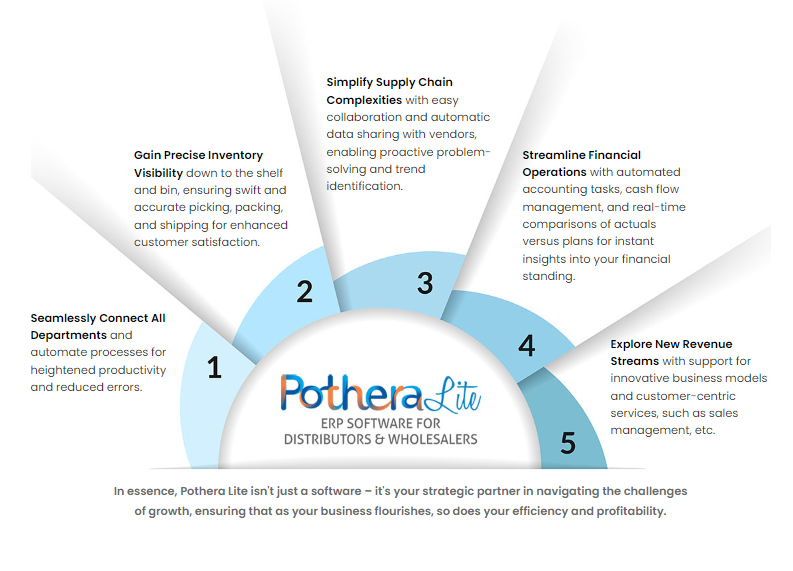
Businesses looking for an ERP solution can evaluate Bsquare Solutions and its ERP platform Pothera based on their specific operational requirements.
Pothera is positioned as an integrated business management platform for businesses that need connected processes across areas such as manufacturing, distribution, trading, inventory, finance, and other operations.
The right ERP should not simply offer many features. It should solve actual business problems.
Before implementation, companies should identify their current challenges, required modules, users, workflows, integrations, and future requirements.
The Benefits of ERP System go beyond simply replacing spreadsheets or disconnected software.
A properly implemented ERP can connect departments, automate repetitive work, improve data visibility, strengthen inventory and financial control, and support faster business decisions.
However, ERP success depends on selecting the right solution and implementing it properly.
For Indian businesses, the best approach is to evaluate ERP based on actual business processes rather than choosing software only because it has more features.
A well-planned ERP implementation can become a strong foundation for efficiency, control, and sustainable business growth.