
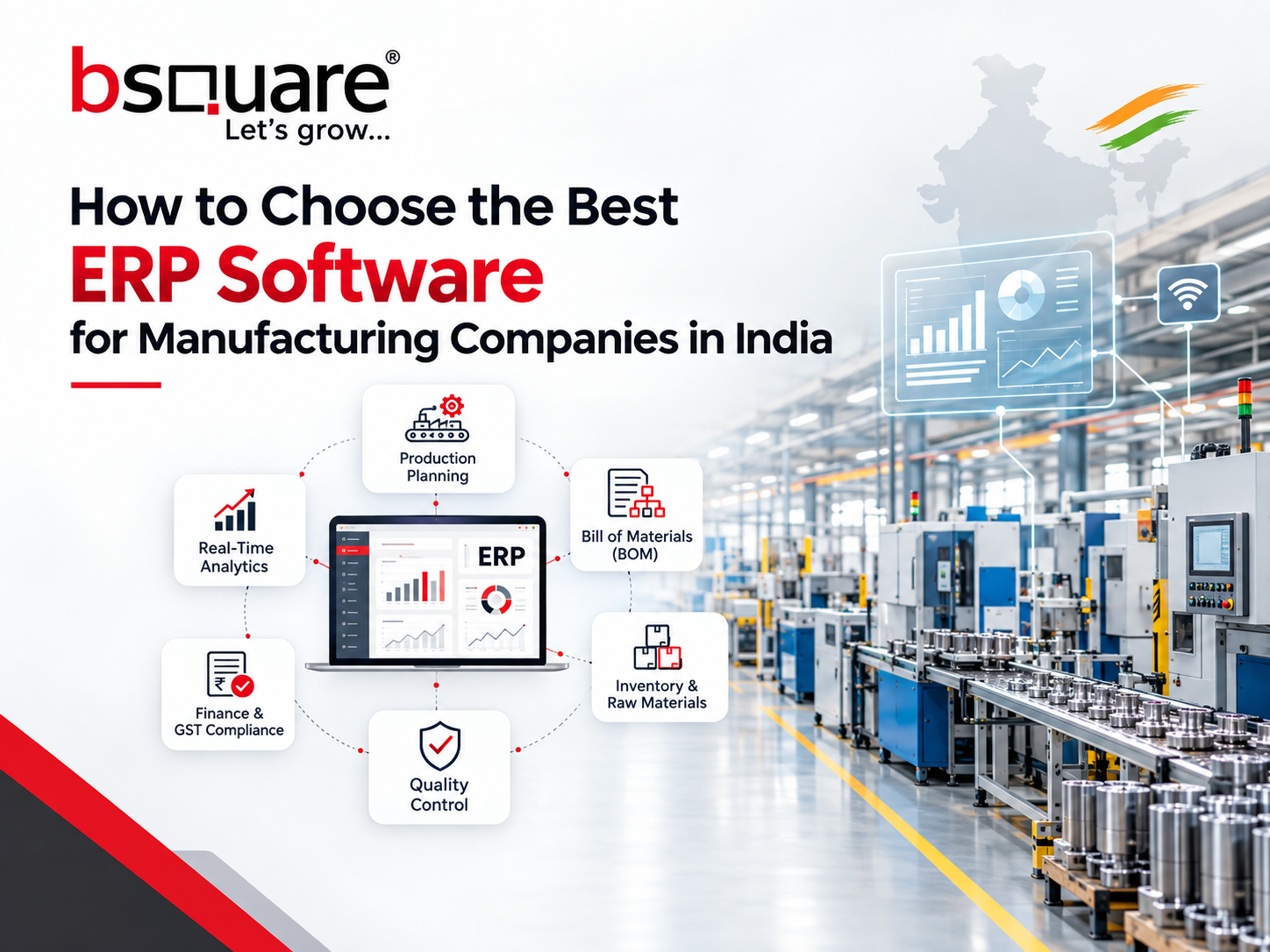
A practical guide to evaluating manufacturing ERP software, essential modules, implementation timelines, GST compliance, costs and long-term support.
The best ERP software for a manufacturing company in India is one that fits its actual production processes, connects departments, supports Indian compliance requirements and can be implemented and supported reliably.
For small and mid-sized manufacturers, the decision should not be based on the number of features advertised or the initial software price alone. What matters is whether the ERP can bring sales, purchases, inventory, production and finance into a connected system that employees can use effectively.
Pothera ERP, developed by Bsquare Solutions Pvt. Ltd., is an option for growing Indian manufacturing and trading businesses. It covers core sales, purchase, inventory and production functions and is GST and e-invoicing ready for the Indian market. Its documented implementation timeline is 8–12 weeks, depending on the requirement.
This guide explains what to look for in manufacturing ERP software, how to evaluate different solutions and what to check before making an investment.
What Is Manufacturing ERP Software?
Manufacturing ERP (Enterprise Resource Planning) software is a business management system that connects the processes involved in running a manufacturing operation.
Instead of maintaining separate records for purchases, raw materials, production, sales and accounts, an integrated ERP provides a common system for managing related business information.
For example, a manufacturer may receive a customer order, check material availability, plan production, arrange purchases and prepare the final invoice.
When departments work through disconnected applications and spreadsheets, information may need to be entered or reconciled repeatedly.
An integrated manufacturing ERP is intended to reduce these information gaps and provide a more consistent operational picture.
Why Do Manufacturing Companies Need ERP Software?
As manufacturing businesses grow, their operational complexity often increases.
A company may have more products, suppliers, customers, warehouses, production activities and employees than its existing systems were originally intended to manage.
Common challenges include:
- Inventory information maintained across multiple spreadsheets.
- Limited visibility into material availability.
- Sales and production teams working with different information.
- Purchase decisions based on manually updated records.
- Difficulty consolidating operational reports.
- Repeated data entry between departments.
- Increasing coordination requirements across locations.
These problems do not automatically mean every manufacturer needs ERP. However, when disconnected systems begin affecting coordination and decision-making, an integrated ERP becomes worth evaluating.
The purpose of ERP is not simply to digitise existing paperwork. It is to connect the information that different teams need to run the business.
What Features Should the Best Manufacturing ERP Software Have?
The required functionality depends on the type of manufacturing business, its production processes and its operational complexity.
However, several capabilities are relevant to many manufacturers.
- Sales Management – Sales teams need a reliable way to manage customer transactions and related information.
When sales information is connected to inventory and other operational functions, departments can work from a more consistent record of customer requirements.
During a demonstration, ask how the ERP handles the sales process relevant to your business.
- Purchase Management – Manufacturers depend on timely purchasing of raw materials, components and other supplies.
Purchase management functionality should be evaluated for its ability to support the company’s purchasing procedures and information requirements.
The important consideration is how purchasing connects with inventory and the wider business process.
- Inventory Management – Inventory management is particularly important in manufacturing because materials may be held at different stages of operations.
Manufacturers should evaluate how an ERP handles their actual inventory requirements, including stock records, material movements and the information needed by purchasing and production teams.
Businesses with multiple warehouses or specialised traceability requirements should request demonstrations of those specific processes.
- Production Management – Production requirements vary considerably across manufacturing industries.
A cable manufacturer, pharmaceutical company, fabrication business and automotive component manufacturer may have very different workflows.
Before choosing ERP software, identify the production activities that the system must support.
Ask the vendor to demonstrate those workflows rather than assuming that every manufacturing ERP handles all production models in the same way.
- Finance and Accounting – Manufacturing operations ultimately affect financial information.
An ERP evaluation should therefore consider how transactions across sales, purchases, inventory and other business functions connect with accounting and reporting requirements.
The precise accounting configuration and any required integration should be confirmed during requirement discussions.
- GST and E-Invoicing – Indian manufacturers must also consider the compliance requirements relevant to their transactions.
Pothera ERP is GST and e-invoicing ready for the Indian market.
Businesses should nevertheless demonstrate their specific transaction scenarios and confirm the exact compliance functionality required.
- Management Information and Reporting – Management teams need information that helps them understand operations and make decisions.
Before choosing an ERP, identify the reports and operational information that different decision-makers require.
A useful demonstration should show how those requirements would be addressed.
How to Choose the Right ERP Software for Your Manufacturing Business
Choosing an ERP involves more than comparing feature lists.
Bsquare recommends evaluating the product demonstration, underlying technology, ease of use, scalability, future-readiness, implementation capability and ongoing support.
Start with Your Actual Business Processes
Document how your business currently operates.
Identify which processes need improvement and which requirements are essential for the first implementation.
For example, a manufacturer may initially require sales, purchase, inventory, production and GST-related functionality.
Other requirements may be relevant later.
This distinction helps define a practical implementation scope.
Request a Process-Based Demonstration
A generic demonstration may show many screens without answering the questions that matter to your business.
Ask the ERP provider to demonstrate a transaction using a realistic example from your operations.
Involve employees from sales, purchase, stores, production and accounts wherever relevant.
Their feedback can help identify practical requirements that management may otherwise overlook.
Evaluate the Technology – Consider the ERP’s architecture, deployment options, integration requirements and ability to accommodate future changes.
The appropriate technical requirements will depend on the organisation’s IT environment and operating model.
Consider Ease of Use – Employees must be able to work with the system in their daily roles.
During evaluation, consider how information is entered, accessed and reviewed, and what training users will require.
Evaluate Scalability – A growing manufacturing business may add products, employees, operational locations or business processes.
Ask how the ERP would accommodate anticipated changes and what additional configuration or commercial requirements may apply.
Give Implementation and Support Serious Attention – ERP selection is also a decision about the organisation responsible for implementing and supporting the system.
Clarify who will manage the project, how requirements will be documented, how issues will be tracked and what support arrangements will apply after implementation.
An ERP that fits the business today should also have a support arrangement the business can rely on as its requirements evolve.
How Long Does Manufacturing ERP Implementation Take?
ERP implementation timelines depend on the scope and complexity of the project.
Factors that can affect implementation include:
- Number of modules and users.
- Business processes requiring configuration.
- Customisation requirements.
- Quality and readiness of existing data.
- Integration requirements.
- Testing and training.
- Availability of the customer’s implementation team.
Pothera ERP has a documented implementation timeline of 8–12 weeks, depending on the requirement.
This can align with a manufacturer’s 2–3 month target where the agreed scope is appropriate, but it is not a guaranteed timeline for every project.
Before committing to a go-live date, the manufacturer and ERP provider should agree on the requirements, responsibilities and implementation plan.
Can Manufacturers Move from Tally and Excel to ERP?
Yes. Businesses currently managing accounting through Tally and operational information through Excel can evaluate a transition to an integrated ERP.
However, moving to ERP requires more than installing software.
Important questions include:
- Which existing records need to be carried forward?
- How accurate and complete is the current master data?
- Is historical transaction migration required?
- Are integrations with existing applications necessary?
- Which processes need to be configured?
- What testing and training will be required?
- How will the operational transition be managed?
Historical data migration, third-party integrations and the transition approach should be assessed and scoped before implementation.
No ERP provider should assume that every business can migrate without operational disruption.
How Much Does Manufacturing ERP Software Cost in India?
There is no single price that applies to every manufacturing ERP implementation.
The overall commercial requirement may depend on the number of users, selected modules, customisation, deployment, implementation services and ongoing maintenance or support.
Two manufacturing businesses with similar revenue may have very different ERP requirements.
For example, one may operate from a single location with relatively straightforward processes, while another may require multiple operational locations and specialised workflows.
Rather than comparing licence prices alone, request a quotation that clearly identifies the included scope and any additional charges.
Bsquare provides requirement-based commercial proposals for Pothera ERP.
Is Pothera ERP Suitable for Small and Mid-Sized Manufacturers?
Pothera ERP is the flagship ERP product of Bsquare Solutions Pvt. Ltd., a Noida-based enterprise software company that is part of The Nambiar Group.
Pothera is positioned for manufacturing and trading businesses, with a documented suitability range of approximately ₹10 crore to ₹500 crore in annual revenue.
Its relevant functional coverage includes sales, purchase, inventory, production and finance, together with GST and e-invoicing readiness for the Indian market.
Pothera supports cloud and on-premise deployment options.
For manufacturers considering Pothera, the most useful next step is to evaluate their actual operational requirements through a product demonstration and requirement study.
Bsquare’s approach to ERP selection is straightforward: the product must fit the business, the implementation must be realistically planned, and ongoing support must be considered from the beginning.
Pothera may be relevant where a manufacturer needs integrated business functionality and values implementation and support alongside software capabilities.
Businesses requiring only a single standalone function, or selecting exclusively on the lowest initial price, may have different priorities.
Manufacturing ERP Selection Checklist
Before finalising an ERP provider, confirm the following:
- Business fit: Can the system demonstrate your actual manufacturing and trading processes?
- Functional coverage: Does it support the required sales, purchase, inventory, production and finance activities?
- Indian compliance: Can it demonstrate the GST and e-invoicing requirements relevant to your business?
- Technology: Does the architecture meet your deployment and future integration needs?
- Usability: Can your operational teams work effectively with the system?
- Implementation: Is the timeline based on a clearly defined scope?
- Data transition: Have migration, integration and cutover requirements been assessed?
- Support: Are implementation ownership and ongoing support responsibilities clear?
- Commercials: Does the proposal explain licence, implementation, customisation and ongoing costs?
- Future requirements: Can the solution accommodate anticipated business changes?
Frequently Asked Questions
Which ERP software is best for manufacturing companies in India?
The appropriate ERP depends on the manufacturer’s production processes, inventory requirements, business size, compliance needs, implementation expectations and support requirements. Pothera ERP is one option to evaluate for small and mid-sized Indian manufacturers requiring integrated sales, purchase, inventory and production functionality.
What is the difference between accounting software and manufacturing ERP?
Accounting software primarily addresses financial records and transactions. Manufacturing ERP is intended to connect a broader set of operational processes, including purchasing, inventory, production and sales, with relevant financial information.
Can small manufacturing companies use ERP software?
Yes. Suitability depends on operational complexity, requirements and available resources rather than company size alone. A small business with relatively simple processes may not need the same ERP scope as a multi-location manufacturer.
Can manufacturing ERP manage production and inventory together?
Manufacturing ERP systems can provide connected production and inventory functionality. The exact workflows supported vary by product and configuration, so manufacturers should request a demonstration of their specific requirements.
Does manufacturing ERP support GST and e-invoicing?
Some ERP systems provide India-specific compliance functionality. Pothera ERP is GST and e-invoicing ready for the Indian market. The exact functionality required should be confirmed during evaluation.
Can ERP be implemented in three months?
It depends on the project scope. Pothera’s documented implementation timeline is 8–12 weeks depending on requirement. A three-month target should be validated through a requirement study rather than assumed.
How should a manufacturer compare ERP quotations?
Compare the total proposed scope, including users, modules, implementation, customisation, deployment, support and ongoing costs. Check that quotations cover equivalent requirements before comparing totals.
Conclusion: Choose an ERP That Fits the Way Your Business Operates
The best manufacturing ERP decision begins with understanding the business—not selecting software based on a ranking or feature count.
For Indian manufacturers, connected operations, GST readiness, usability, implementation planning, scalability and ongoing support are important evaluation factors.
Pothera ERP brings together the core functions relevant to many growing manufacturing and trading businesses. Whether it is the right fit for a particular organisation should be established through a demonstration and detailed requirement discussion.
Looking for manufacturing ERP software for your business?
Connect with Bsquare Solutions to discuss your manufacturing processes, explore Pothera ERP and request a requirement-based implementation proposal.
Book a Pothera ERP Demo: https://www.bsquare.in/